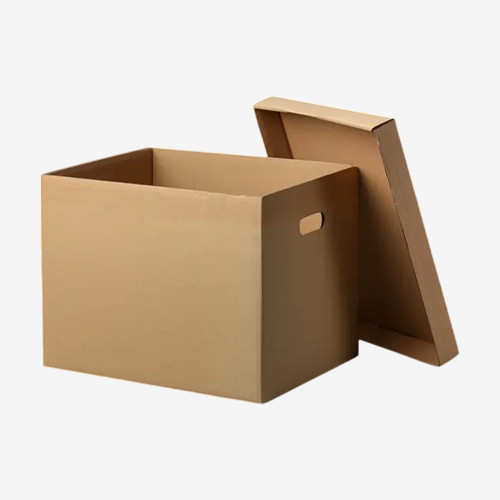

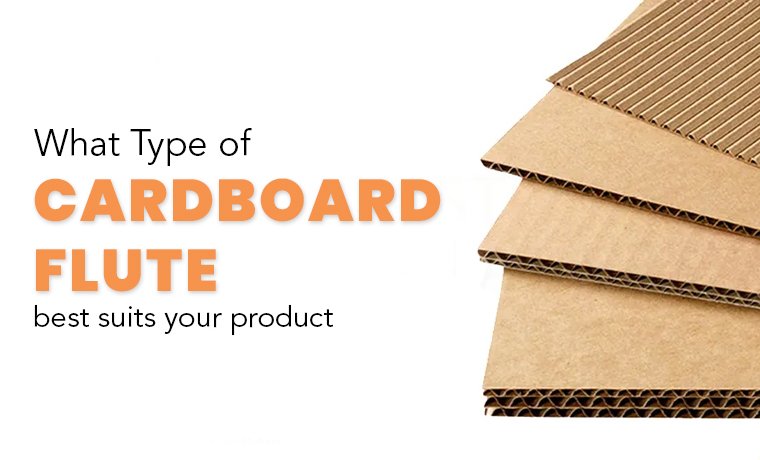
Have you ever picked up a cardboard box and wondered why, rather than feeling limp like a damp handkerchief, it seems so structured and bouncy? That is fluting's magic. Yes, fluting is a key component that transforms ordinary cardboard sheets into packing superheroes.
Today, we’re going deep into the world of fluting: from terms, definitions, and real-life applications to sizes, types, and how to pick the right flute for your packaging needs. After all, a suitable type of cardboard flute can make the difference between how well your product will be packaged, presented, and preserved.
You will learn about E-flute packaging, F-flute corrugated board, multi-wall structures, contra flute, and more! This ride is entertaining, educational, and possibly even a touch "flute-y," so fasten your seatbelt.
What Is Fluting?
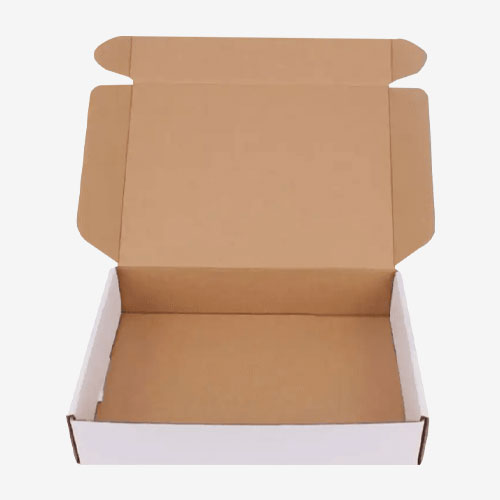
One should be familiar with the structure before comparing the types of flutes. The wavy, rippled layer in the middle between two flat layers (liners) of a corrugated board is called the fluting. It forms air pockets, which provide the waves with compression strength, shock absorption, and stackability. Moreover, fluting controls:
- Cushioning performance
- Box strength
- Board weight
- Print surface smoothness
- Folding precision
- Shipping durability
Corrugated Flute Sizes
The flutes are of different heights and densities. The bigger the flutes, the more cushioning they provide, whereas the smaller the flutes, the smoother the print-surface and the smoother the presentation.
- Big Flutes (A, C)→ More cushioning
- Small Flutes (E, F) → Retail + premium printing
- Multi-Wall (BC, EB, etc.) → Intensive usage.
Product fragility, branding goals, and handling conditions are a few of the many factors that will determine the choice that you will make for custom boxes.
What Are Corrugated Cardboard Flute Types
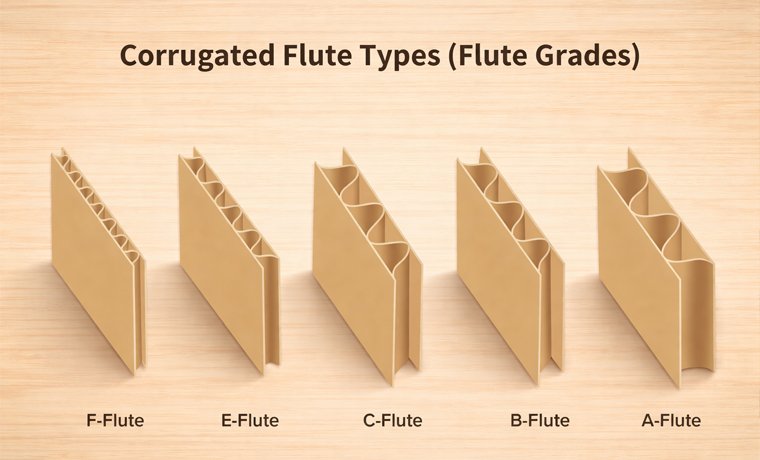
There is no one-size-fits-all solution for corrugated cardboard. There are various varieties of cardboard flutes, each with a distinct rhythm and function. This is your cheat sheet:
The OG “A Flute”
Superior Cushioning and Shock Absorption!
Not super common today, A flute is known to have excellent cushioning. In simpler words, tall arches equip it with a higher level of shock resistance and crush protection, making it the best choice when safety is more important than beauty. On the downside, the surface is slightly less printable and fails to give a super-smooth finish due to its height. But who cares? It will provide unmatched structural support!
This type is best for:
- Shipping boxes for items that demand extra padding
- Retail boxes
- E-commerce boxes
- Folding cartons
- Food, Beverage, and Electronics packaging boxes
- Pharmaceutical packaging boxes
Versatile “B Flute”
Good at Strength and Die-Cutting!
Featuring medium height with tighter waves, B Flute is a finer version of A but with more strength at the walls. Also, it has superb puncture resistance and printability. This flute is often the go-to for retail packaging where designs matter as much as strength. The best part is how it folds well with more flutes per foot. The result? You can make die-cut structures.
The B flute finds its use in:
- Food boxes
- Beverage carriers
- Moving boxes
- Product storage boxes
- Corrugated Mailer boxes asking for moderate-level protection
- Shipping boxes where stackability is a priority feature.
Workhorse “C Flute”
The International Standard of Shipping Boxes!
C Flute is the most used type of flute around the globe since it balances cushioning, compression strength, and print quality. Besides, it caters to warehouse stacking. Most importantly, this type becomes a preference when the brands require a reliable yet economical solution.
Where is the C flute used?
- General products shipping boxes
- E-commerce boxes seeking boosted toughness.
- Retail display boxes
- Mailer boxes
- Storage boxes
- Export cartons
The Retail “E Flute” Hero
Petite, Thin, and Chic = Display Expert!
Perfect for packaging where smooth printing surfaces are needed, E Flute is thinner and denser. Its small form gives it a sleek surface, which is perfect when it comes to branding in detail. Moreover, e-flute packaging is the most popular when it comes to cosmetic, jewelry, food, and apparel brands.
The best uses of the E flute are:
- Luxury boxes
- Retail Kraft corrugated boxes
- Food packaging (bakery boxes, chocolate boxes)
- Small consumer goods boxes
- Gift boxes
- E-commerce shipping boxes (small to medium)
F Flute - ideal for luxury branding and small electronics
This flute is much narrower and smoother, which is best suited to small products that are based on presentation. Additionally, it can be used in the cosmetics, technology, and luxury markets, as well as in fancy packaging where every millimeter counts.
Great choice for:
- Gift boxes
- Luxury product boxes
- Cosmetic packaging boxes
- Jewelry boxes
- Small retail product boxes
- High-end food boxes (like chocolates or pastries)
- Display boxes
- Pharmaceutical packaging boxes
- Premium subscription kits
A Detailed Corrugated Flute Chart
To easily compare flutes and discover their thicknesses, wave heights, and ideal use cases, review our corrugated flute chart.
| Flute Type | Approx. thickness | Flutes per foot | Characteristics | Best For |
| A Flute | 5mm | 33 | Excellent Cushioning, Tall waves | Fragile Products, heavy items |
| B Flute | 3mm | 47 | Strong walls, Good stacking | Food boxes, shipping, die cuts |
| C Flute | 4mm | 39 | All-purpose durability | Shipping boxes, general packing |
| E Flute | 1.5mm | 90 | Smooth print surface, thin | Retail, cosmetics, branding |
| F Flute | 0.8mm | 125 | Ultra-thin premium finish | Electronics, luxury goods |
| Double Wall (BC/E), etc | 6-8mm | Mixed | High-strength multi-layered | Machinery, bulk industrial |
Single-Wall, Double-Wall, and Beyond
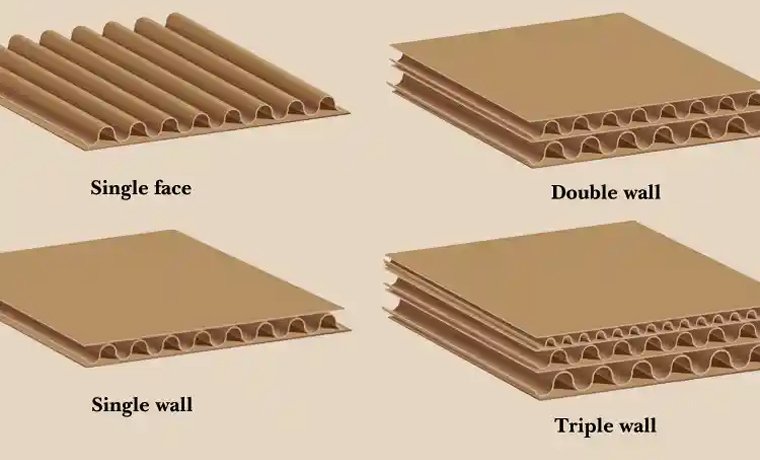
You might see terms like e flute single wall or F flute double wall. Here’s the lowdown:
- Single-wall: Two liners and one fluted layer, most popular, adaptable, and affordable.
- Double-wall: Two fluted layers (like B+C), extremely robust, and ideal for bulky or delicate objects.
- Triple-wall: Three layers of fluting; consider a packaging with industrial robustness.
Your corrugated board flute kinds are crucial in this situation. You can avoid overpaying for unnecessary cardboard or, worse, under-protecting your goods by matching the type of flute with the wall construction.
Understanding Contra Flute
For those who are interested in packaging, here's some interesting information…
Have you heard of the contra flute? This happens when two corrugated sheets with perpendicular flutes are bonded together. Yes, in a contrary direction in multi-wall corrugated boards. Why? To increase rigidity in every angle.
It is 100% recommended for lengthy transport boxes that require flatness and stacking strength. Moreover, this method reinforces packaging without significantly adding board thickness. Common uses for contra include:
- Heavy-duty shipping boxes
- Furniture packaging boxes
- Appliance boxes
- Electronics packaging boxes
- Industrial equipment boxes
- Large product cartons
- Palletized boxes
A Guide to Making the Smart Choice
Every choice affects perception, protection, and the consumer experience, from materials and construction to design and finishing. This handbook assists you in navigating possibilities, making well-informed decisions, and designing packaging that benefits your brand and produces outcomes.
The following is a checklist of a basic selection:
1. Start with Product Weight
- Heavier products → B, C, BC
- Lightweight retail items → E, F
2. Consider Fragility
- High fragility → A or C
- Moderate sensitivity → B
- Retail/Premium → E or F
3. Assess Branding Requirements
- Fine prints require smoother surfaces, E, F.
- Basic designs → B, C
4. Look at Shipping Distance
- Long routes require a fluter of greater power, B, C, BC.
- Short routes → E, F
5. Factor in Conditions of Storage
- High stacking = B or C
- Retail shelves = E or F
Conclusion
The best cardboard flute type for your product depends on several factors: weight, fragility, shipping conditions, branding, and budget. Whether you choose A Flute for cushioning, B Flute for strength, C Flute for versatility, or E and F Flutes for premium presentation, understanding corrugated cardboard flute sizes ensures smarter packaging decisions.
Use this guide, compare flute options through the provided charts, and test materials before finalizing your packaging design. And when you’re ready to create tailored solutions that strengthen your brand, Custom Product Packaging is here to help. Not sure what to choose? Don't fret, call us at (+1)888-511-0592 and get a free consultation.