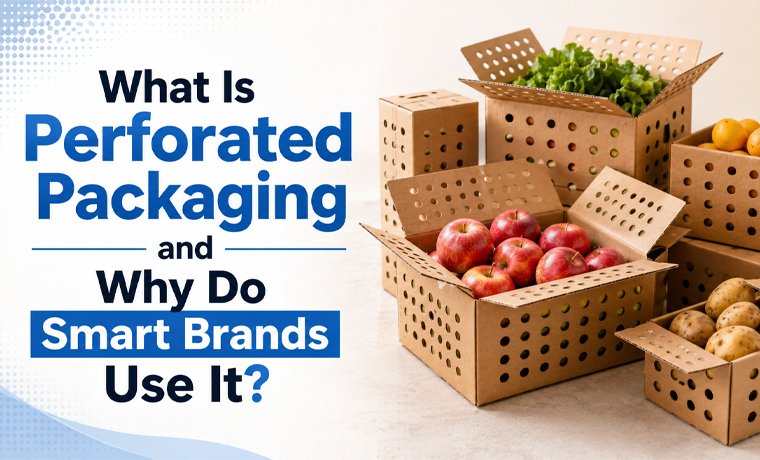
What Is Perforated Packaging and Why Do Smart Brands Use It?
September 30, 2026
Imagine opening a bag of salad, and it is still crisp and fresh…Or berries that have not gotten mushy. This is no coincidence; this is perforated packaging at work. After all, your product should be properly and fittingly packaged for safe delivery to the desired destination. Secondly, packaging has advanced much beyond simple plastic wraps and cardboard boxes.
With more than $1 trillion dollars in food waste lost to the global economy every year, brands are using perforated film to gain a competitive edge when it comes to food packaging and related solutions. Perforation has emerged as one of the most useful and ingenious packaging elements in contemporary industries, from snack pouches to bakery wraps, shipping cartons to retail displays.
This guide will explain all you need to know about what the term perforation means, why it's important, and how it can change your packaging line, now. If the freshness, shelf look, and sustainability are priorities for your brand, then read on!
Introduction of Perforated Packaging | A Simple Breakdown
First of all, let's get to the basics.
So, what is perforated packaging? It's a material, a film, a cardboard box, or a board, with holes, slits, or punctures intentionally created on any suitable side of the box. These openings let air, moisture, and gases flow through them in a controlled manner.
Well, perforated packaging isn't all about holes in packaging. You can say it is a scientifically thought-out design that is used to control the internal environment of a package to maintain its contents - be it a bag of herbs, a tray of mushrooms, or a box of artisan cookies.
Most importantly, it creates a cleaner opening experience with no struggles of using scissors or ripping open packages unevenly.
In packaging, perforations can be large visible holes, tiny needle-like openings, laser-cut micro holes, or die-cut tear lines. Moreover, the size and placement depend entirely on the packaging purpose.
Modern perforated boxes are heavily used in:
- Food preservation
- Moisture control
- Ventilation
- Product visibility
- Portion dispensing
- Retail presentation
- Shipping efficiency
The Technique & Science Behind!
For those who don't know, the vegetables that were once cut in the field stay fresh for longer. It still breathes; it gives off CO₂ and takes in O₂. That is the reason that it rots more quickly without ventilation. This is where perforated packaging film comes in handy by establishing a Modified Atmosphere (MA). It is defined as a controlled gas environment that helps to slow respiration, delay spoilage, and greatly extend shelf life.
Tip: The correct size, frequency, and spacing of holes is a critical issue when considering the amount of oxygen allowed in and carbon dioxide allowed out.
A standard punctured box will get a comparable effect with bulkier things. With intentional openings in corrugated boxes or kraft packages, brands can allow air to flow in, which helps to keep moisture out of the packaging and product. It maintains the integrity and quality of products.
However, micro-perforated packaging goes the extra mile. Micro perforated film packaging has laser-drilled or needle-punched holes, which are too minute to be seen by the naked eye. Still, they are large enough to control gas transfer with amazing accuracy.
Machinery + Equipment:
Further, the science behind perforation is surprisingly smart. Tiny holes or cut patterns are added using the following approaches, as the design needs to be exact. While too few holes could lessen the package's usefulness, too many could make it weaker.
- Mechanical punching
- Laser perforation
- Needle perforation
- Rotary die cutting
Read More: How Does the Packaging Production Process Work?
Environmental Benefits of Perforated Packaging
Sustainability doesn't come as a choice anymore; it's a necessity. Fortunately, perforated packaging fits in with the goals of green. Here is how:
- One advantage of these thinner films with the micro-perforated film packaging is that they require less raw material.
- Secondly, less food is wasted in landfills as it doesn't go to waste.
- Thirdly, a lot of cardboard packaging with holes is made from recycled and certified by FSC materials, and is easily recyclable or compostable.
Fact: The sustainable flexible packaging market comprises perforated film used in food packaging, and is expected to grow to $48.8 billion by 2029, according to a 2025 industry report by Smithers Market Research. Much of that is being fuelled by smart and breathable packaging options replacing traditional sealed packaging options from food brands.
Perforated Packaging in the Food Industry | Real-World Applications
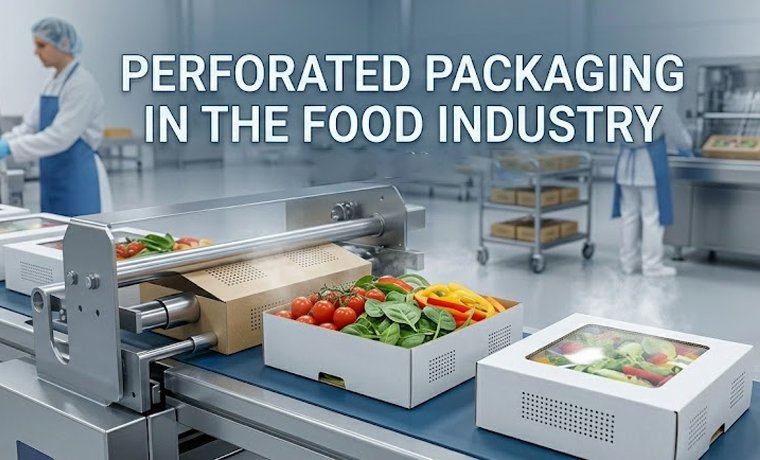
Now let's examine these real-life applications of food-perforated packaging.
New Fruit and Supermarkets:
In the fresh departments of the supermarket, the use of perforated cardboard packaging and micro-perforated film packaging is widespread. Precise gas exchange of spinach bags, cucumber sleeves, and pre-cut fruit trays benefits all. This helps to increase the length of time a display lasts and to decrease the amount of waste created at the end of the day.
Artisan Food Brands and Bakeries:
Water is the enemy of crispy bread! With a good perforated packaging solution, baked goods can breathe throughout the process without losing their texture and aroma. The perforated bakery boxes provide a great visual brand and are extremely functional, which is a favorite among artisan brands.
A Collection of Herbs, Salads, and Tender Greens:
These are the packaging products that are the most difficult. They are very sensitive to wilting, bruising, and need a specific gas balance. Micro-perforated packaging is designed to fit this type of packaging. This is now the standard for top brands of salad and herb crops, as no other packaging surpasses it in shelf life performance.
Comparison of Different Packaging Styles
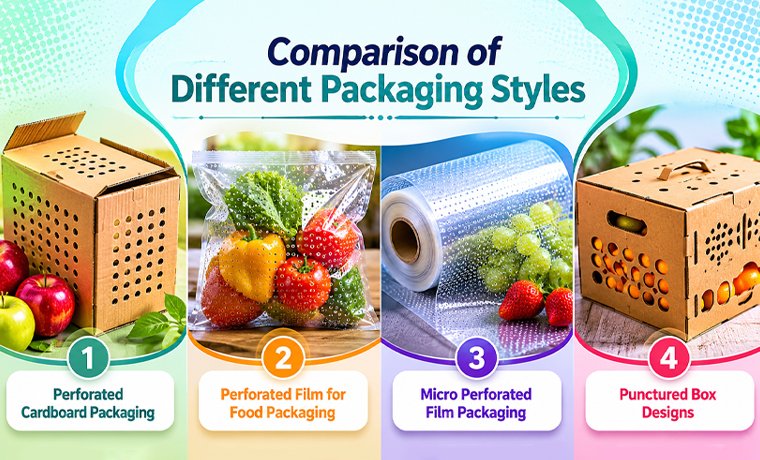
Here’s the complete breakdown of different packaging types and their advantage:
| Packaging Type | Breathability | Best For | Film Type Used |
| Standard Box | None | Dry goods, electronics | Solid board |
| Perforated Cardboard | Moderate | Produce, bakery items | Perforated board |
| Perforated Film Wrap | High | Fresh fruits & veggies | Micro perforated film |
| Micro Perforated Pack | Very High | Salads, herbs, berries | Micro-perforated film packaging |
| Punctured Box Design | Low-Moderate | Display & retail items | Kraft / corrugated board |
1. Perforated Cardboard Packaging
Perforated cardboard boxes are generally used for fresh fruit, bakery, and display boxes. It is also durable, eco-friendly, and printable, making it a popular choice for brands that are looking to brand. The holes are sometimes punched into geometric designs, which serve as a decorative element. Moreover, this is desirable for brands due to its decent look and usefulness.
2. Perforated Film for Food Packaging
Perforated film for food packaging is a transparent or semi-transparent plastic or biobased wrap having holes created at specific locations. Some common materials include Polyethylene (PE), Polypropylene (PP), and PET films. It can be used for fruits, vegetables, and bakery products.
The shoppers will be able to see the product inside, which will increase their purchase confidence and decrease the number of returns.
3. Micro Perforated Film Packaging
For sensitive foods such as salad, herbs, cherry tomatoes, and mushrooms, micro-perforated packaging is the best option. A study published in the journal Packaging Technology and Science (2024) found that the micro and invisible holes enable the perfect level of oxygen to enter the package and CO₂ to escape the contents, which can stay fresher up to three times longer than with traditional packaging.
4. Punctured Box Designs
A punctured box will usually be used for shipping and retail displays. It is especially used for horticultural crops, such as apples, citrus fruits, and root vegetables, which require only slight but continuous ventilation during transport and storage.
A Smart Shift Towards Perforated Packaging
There is a reason for brands to invest in new packaging. But why the food perforated packaging hype? The solution is four great benefits for business:
More Shelf Life:
Spoilage is greatly reduced with perforated film. This also translates to reduced markdowns and waste for the retailers. For consumers, it's a product that is fresher and better each time.
Less Food Waste:
The Food and Agriculture Organization (FAO) estimates that approximately one-third of all food that is produced worldwide is lost or wasted. Perforated solutions and particularly those with micro-perforations, are directly involved in reducing that number.
Improved Product Visibility:
Clear perforated packaging film allows customers to view the product. This transparency has a positive impact on trust and accelerates impulse buying at the point-of-sale.
Sustainability credentials:
Many holes have thinner films or recycled content boards. This equates to less material and still provides protection. In 2025, it's especially important for those who want to be more environmentally friendly.
Brand Differentiation:
A box with beautiful perforations is noticeable on the shelf. The holes can be part of the pattern, establishing a sort of identity for the pattern - something which is not easily replicated by competitors.
Conclusion
Perforated packaging is no longer a 'specialist' product; it's a 'good business' product. The advantages are evident, tangible, and immediate. From the ability to extend shelf life through the use of micro-perforated film packaging, to help keep food from getting wasted through the use of perforated cardboard packaging.
Further, the choice of perforated packaging can make a difference to the bottom line, sustainability efforts, and customer satisfaction. Today's market winners on the shelf are those that have invested in smarter and more breathable packaging. Don't let old packaging limit your product.
We know how difficult it can be to make the transition, and Custom Product Packaging is here to assist you. Give us a call today at +1(888)-511-0592 and let's create packaging that will work just as hard as your product.