
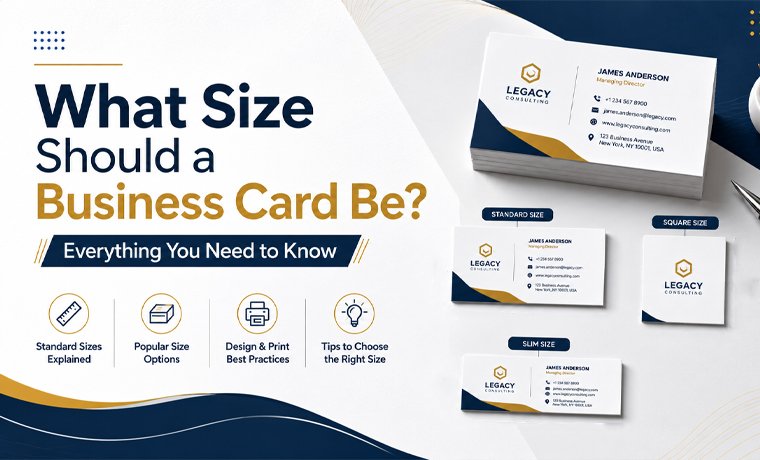
The accuracy of your business card size in the fast-paced 2026 networking environment shows your professionalism. The industry standard is still 3.5 x 2 inches, but the shapes and digitally-integrated designs vary from company to company. The right size means that your card will fit into normal wallets and will not be disposed of or lost.
Outside the physical boundaries, it is important to learn the meaning of bleed (space outside the cut zone) and safe (space inside the cut zone) to prevent the loss of important contact information in the high-speed printing process.
When you design in line with international standards, you are showing that you are keen on detail and international standards. You will find either a traditional US design or a smooth European-style with a Credit Card, but the objective is the same: to hit the target professionally. Moreover, it is possible to use the latest features, such as QR codes, to overcome the space between the physical cards and online profiles. This makes your data readily available.
To have detailed information on business card sizes, this blog is for you.
What Is the Standard Business Card Size?
The typical card size used across most industries is carefully chosen for ease and compatibility. Give a look at this table for a quick understanding:
| Format | Size (Inches) | Size (mm) | Size (mm) | Pixels (300 DPI) |
| US Standard | 3.5 x 2 | 88.9 x 50.8 | 8.89 x 5.08 | 1050 x 600 |
| Europe Standard | 3.35 x 2.17 | 85 x 55 | 8.5 x 5.5 | 1004 x 650 |
| Japan Standard | 3.58 x 2.17 | 91 x 55 | 9.1 x 5.5 | 1075 x 650 |
Business Card Size in Different Units (Cheat Sheet Time!)
Let’s break down business card measurements so you never get confused again.
Inches (Most Common): 3.5 x 2 inches
Millimeters (business card size mm): 88.9 x 50.8 mm
Centimeters (business card dimensions cm): 8.89 x 5.08 cm
Points (Business card size in pt – design world loves this): 252 x 144 pt
So if a designer says “set it in pt,” don’t panic—they just live in a slightly more pixel-perfect universe.
Importance of Business Card Size
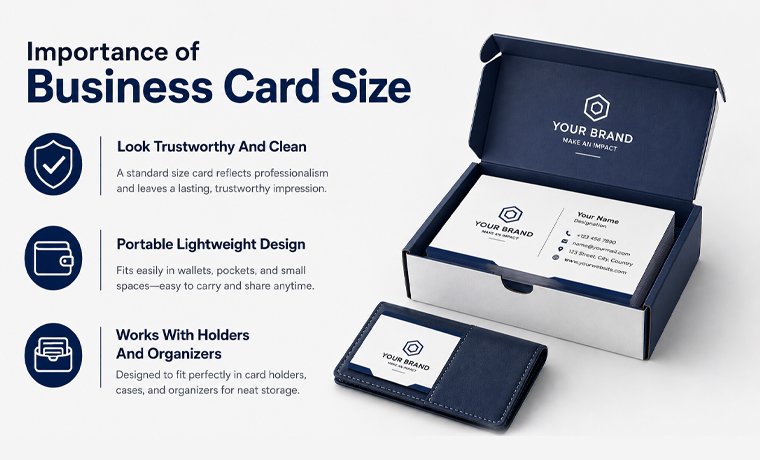
A small rectangular cardboard, often between 300 and 350 GSM, forms the base of most business cards. Usually coated in soft silk or a flat matte finish for grip and look! Across the U.S., they measure exactly 3.5 inches long by 2 inches tall. This is just to fit into any wallet without creating fluff. That particular shape keeps names, numbers, and titles clear to read at a first glance. Because it sits neatly in hand or pocket, it also feels deliberate, put-together.
Well, these pointers work for all types of custom cards.
Look Trustworthy And Clean
Right off, a well-cut card sets you apart!
Handing over this card to the passers will quietly tell them about your business quickly. Too large or too tiny cards feel sloppy, maybe even careless. Sticking to the norm just lets everything click when you meet face-to-face.
Portable, Lightweight Design
A slim design slips into pockets, slides into wallets, tucks inside tiny bags.
Wherever people head each day, those plastic cards remain flat, tough, and never fold. Carrying it feels natural, so most won’t toss it aside after one glance. When someone hunts for your number later on, there it sits, clean and ready. Time passes, but the corners stay sharp, the print clear.
Works With Holders And Organizers
Some people stash business cards in slim binders or clear pockets. So, get one that slips neatly inside, no snagging, never slipping free. When it slots into place cleanly, they tend to leave it close at hand. Your details stay within reach!
Factors to Consider
The following are some factors to consider when choosing the business card size:
Industry Needs:
Big companies stick to usual measurements. But the size and design vary with time and conditions.
Design Complexity:
Folded or bigger cards might be needed if there is too much to include. Lengthy details often lead to bulkier formats. You can apply this to thank-you cards, too.
Branding Goals:
Unique sizes feel like a new thing to the public. It can help you make your own name in the market.
Custom vs Standard:
A single standard keeps things working smoothly. On the flip side, custom choices bring a distinct flavor. One follows the path laid out. The other carves a new direction entirely.
Types of Business Card Size
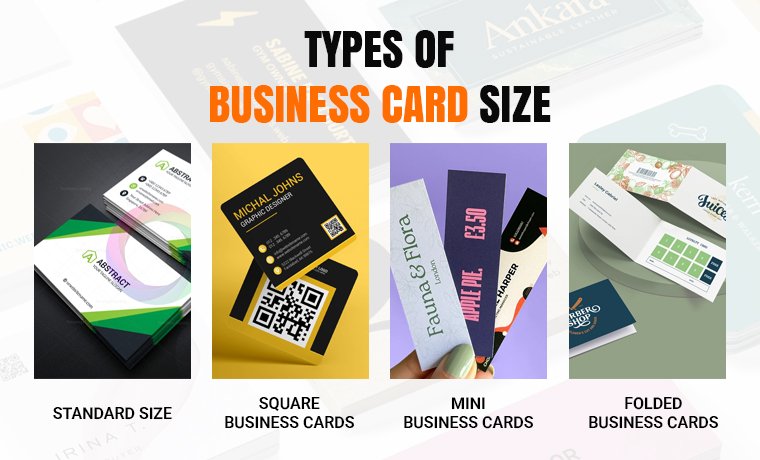
Yes, it is the most important part when it comes to designing.
Standard Size
A small rectangular shape shows up most often on desks and in wallets. This particular fits neatly into standard holders everywhere. Professionals in offices tend to pick it without thinking twice. Also, its familiarity makes it feel natural during meetings.
Square Business Cards
With sharp edges and clean lines, these cards catch the eye fast. Because of their size, slipping into standard slots can be tricky - so they work best where rules are loose, and ideas lead.
Mini Business Cards
Small by design, these little cards give a clean look, great for simple brand styles. Still, fitting everything clearly takes extra thought since the room to work with runs short.
Folded Business Cards
A little more space hides inside when you open one of these cards. Businesses find it handy for slipping in service notes, product lines, or special offers, without everything piling up on a single face.
Business Card Size in Different Countries (Quick Reality Check)
While 3.5 x 2 inches is the global favorite, here are a few variations:
- UK & Europe: 3.35 x 2.17 inches (85 x 55 mm)
- Japan: 3.58 x 2.17 inches (91 x 55 mm)
- India & Pakistan: Mostly follow 3.5 x 2 inches but sometimes 3.54 x 1.97 inches
Therefore, while your card may be able to go abroad, the wardrobe size may not always be the same.
Design a Professional Business Card
To design a professional business card, stick to the following factors to perform well:
Select Appropriate Text Size: Size matters when it comes to text on a business card - stick to 8 through 12 points so people can actually read it. A bit bigger font for your name helps it catch the eye.
Maintain Proper Resolution: Aim for 300 DPI when setting up business card artwork so the print comes out crisp. Besides, sharp details depend on that number every time. Hitting it means edges stay clean, text stays readable.
Layout and spacing matter: Empty areas on a page help keep things clear. When elements are spaced out, your eyes move more easily. Too much stuff close together feels heavy. Additionally, breathing room between parts makes a difference. A clean layout often means better understanding!
Strong Visual Hierarchy: Finding what matters should be quick - your name, how to reach you, things like that. Place them where the eyes go first. Not buried, never hidden by less crucial bits. Imagine your wedding card…even it comes with a decent hierarchy.
Select The Right Finish: Frosted finishes, shiny surfaces, or slick top layers change how your card looks and handles. Further, a dull surface might catch light differently from a glossy one. Each option gives a different texture under the fingers.
Conclusion
The choice of right-size sounds ordinary, but it has a great role in marketing the product. The dimensions matter just as much as layout or image clarity. Each choice has a different impact on every mind!
A card that fits comfortably in the hand often works better than bigger ones. Even after following standard dimensions or branching into unique shapes, make sure readability stays sharp, and handling feels natural.
Start designing standard business cards today by calling Custom Product Packaging at (+1)888-511-0592 and change how your brand shows up. Since strong first impressions matter, get in touch now through a quick phone call. Because details shape perception, choosing quality packaging makes a difference!
Frequently Asked Questions
Actually, the usual measure is 3.5 by 2 inches. Smaller than that, a 2x3 piece feels cramped - rarely seen around here.
A full page usually holds ten regular business cards, though the exact count shifts with gaps and edges. Spacing changes how many slides are on each sheet. Besides, bleed adjustments nudge the total one way or another.
Most of the time, a standard business card comes out around 3.5 by 2 inches - though that can shift just a bit depending on where you are in the world.
What often trips people up? Squeezing in too many details, cluttering the layout so nothing stands out clearly. Reading becomes a struggle when visuals get buried under layers of data.